
5
Foundation beds are often the first thing people notice about a home, yet they carry responsibilities that extend far beyond curb appeal. Unlike an island bed in the middle of the lawn, the ground cover you place directly against your house interacts with structural concrete, siding, perimeter drainage, and subgrade pest barriers. Choosing the wrong material can trap moisture against your sill plates, bake plant root systems against warm masonry, or create an expensive maintenance headache five years down the line.
Homeowners usually find themselves torn between two perennial favorites: organic wood mulch and decorative landscape rock. While both serve to suppress weeds and define borders, they function in completely opposite ways beneath the surface. Deciding which one belongs along your foundation requires weighing plant health against home preservation, upfront labor against recurring costs, and short-term aesthetics against long-term maintenance reality.
The Unique Demands of Foundation Beds
Before comparing materials, it helps to understand why the immediate perimeter of a house presents a uniquely challenging environment for plants and landscaping materials alike.
A foundation bed is bounded on one side by an immovable vertical barrier: your home. This wall creates microclimates. South- and west-facing walls absorb solar radiation throughout the day and radiate heat long after sunset, elevating ambient soil temperatures well above typical yard levels. Conversely, north-facing foundations often sit in perpetual shade and dry out slowly, creating conditions ripe for fungal growth and persistent dampness.
Furthermore, building codes require soil to slope away from the foundation at a minimum drop of six inches over the first ten feet to ensure proper runoff. Any material you install must not impede this grade, trap standing water against the slab, or bridge the gap between bare ground and exterior siding. When evaluating ground cover, your first priority must always be preserving the structural envelope of the home, with plant vitality and visual preferences coming second.
Organic Mulch: The Case for Wood Chips and Shredded Bark
Organic mulch—typically derived from shredded hardwood, cedar, cypress, or pine bark—is the traditional choice for residential garden beds. Its popularity is largely rooted in how well it mimics the natural forest floor.
Superior Soil and Plant Health
The primary advantage of organic mulch is its biological benefit to the soil. As wood mulch breaks down, it introduces valuable organic matter into the topsoil. This continuous decomposition improves soil structure, feeds beneficial microbes, enhances aeration, and regulates moisture levels.
During scorching summer months, a three-inch layer of shredded bark acts as an insulator, keeping shallow root zones significantly cooler than bare earth. In winter, that same layer shields roots from frost heaving caused by rapid freeze-thaw cycles. For foundation shrubs that already face thermal stress from nearby exterior walls—such as boxwoods, hydrangeas, and rhododendrons—organic mulch provides an indispensable thermal buffer.
Moisture Regulation and Absorption
Shredded mulch absorbs rainfall, slows surface runoff, and allows moisture to percolate gently into the ground rather than pooling or scouring the soil away from the foundation. Because it breathes easily, it prevents rapid surface evaporation while still allowing excess moisture to escape into the atmosphere.
The Foundation Risks of Organic Mulch
Despite its horticultural benefits, wood mulch carries genuine risks when applied carelessly against a structure:
-
Pest Attraction: While wood mulch does not generate termites out of thin air, it creates the dark, moist environment subterranean termites seek when foraging for cellulose. Carpenter ants, earwigs, and sowbugs also thrive in deep, damp mulch layers.
-
Rot and Siding Damage: Piling mulch too high against siding, brick weep holes, or stucco creates a capillary path for water to travel into wall cavities, leading to wood rot, mold, and ruined interior drywall.
-
Decomposition and Annual Labor: Because organic mulch breaks down, it must be replenished every one to two years to maintain its color and weed-suppressing depth. Over time, failing to remove old, compacted layers can lead to thick, crusty mats that actually repel water.
To use organic mulch safely along a foundation, always observe the six-inch rule: keep mulch at least six inches below the bottom edge of your siding, and leave a bare four- to six-inch gap between the mulch layer and the exposed foundation wall.
Landscape Rock: The Case for Gravel, River Rock, and Stone
Decorative stone—ranging from smooth river rock and pea gravel to crushed granite and lava stone—delivers a crisp, modern aesthetic that appeals to homeowners looking for permanence.
Structural Protection and Pest Resistance
Stone shines brightest when it comes to safeguarding the house itself. Rocks do not decompose, do not retain damp surface moisture against masonry, and do not provide a food source for wood-destroying insects.
Termites require a continuous moisture bridge to travel above ground safely; an exposed bed of dry river rock provides the opposite, creating an arid, inhospitable barrier right against the concrete. Additionally, heavy stone will not wash away in downpours beneath un-guttered roof valleys, nor will it scatter when hit with a leaf blower or strong wind.
Longevity and Fire Safety
Where organic mulch requires ongoing purchases and annual hauling, stone is essentially a one-time material purchase. Once installed correctly, rock does not rot or blow away, retaining its general presence for decades.
In regions vulnerable to wildfires, stone ground cover is widely recommended as a defensible-space buffer. Replacing flammable dry bark with non-combustible river stone within the immediate five-foot zone surrounding the house reduces the risk of wind-blown embers igniting the structure.
The Hidden Downsides of Stone Around Foundations
While stone is marketed as an effortless, maintenance-free solution, practical ownership often tells a different story.
Extreme Heat Retention
Stone acts as a massive thermal battery. Throughout the day, rocks absorb solar energy, reaching surface temperatures that can exceed 140 degrees Fahrenheit under direct sun. In foundation beds, this heat reflects onto nearby exterior walls and transfers deep into the ground, literally baking shallow root systems. Sensitive shrubs frequently suffer from leaf scorch, moisture stress, and stunted growth in rock beds, requiring significantly more supplemental irrigation simply to survive.
The Weed Barrier Dilemma
Rock must almost always be installed over a heavy-duty geotextile weed fabric to prevent the stones from sinking into the soil beneath. While this setup works flawlessly for the first two or three seasons, windblown dirt, tree pollen, and decaying leaves eventually settle between the rocks on top of the fabric.
Within a few years, this accumulated silt forms a shallow layer of dirt above the cloth. Weed seeds dropped by birds sprout vigorously in this layer, sending roots downward through the fabric weave. Weeding a rock bed by hand is painful, labor-intensive work, and pulling plants rooted through woven plastic often tears the underlayment, ruining the entire installation.
Soil Alteration and Difficult Remediation
Certain stones, particularly limestone and crushed marble, leach minerals into the soil over time, gradually raising the pH. For acid-loving foundation staples like azaleas, camellias, and hollies, this can cause iron chlorosis and chronic decline. Furthermore, if you ever decide to redesign your landscape or plant new shrubs, digging through hundreds of pounds of compacted rock and fabric is grueling work compared to slicing through soft organic mulch.
Direct Comparison: Mulch vs. Rock
| Consideration | Organic Mulch | Decorative Rock |
| Plant Health | Excellent; feeds soil, regulates temperature, moderates moisture | Fair to poor; elevates soil heat, provides zero organic nutrition |
| Pest Mitigation | Requires careful clearance to avoid harboring termites and ants | Excellent; inert, dry surface discourages subterranean pests |
| Upfront Cost | Low initial expenditure for materials and delivery | High initial cost for stone, landscape fabric, and heavy labor |
| Long-Term Labor | Predictable; requires periodic top-dressing every 1–2 years | Low initially; extremely difficult restoration after 5–7 years |
| Stormwater Runoff | High absorption; slows water flow and prevents scouring | Low absorption; allows rapid water flow, requires good sub-grading |
| Fire Resistance | Flammable when dry; poses risk in wildland-urban zones | Completely non-combustible; ideal for fire-wise defensible space |
The Two-Zone Strategy: The Smarter Hybrid Approach
You do not have to choose strictly between the risks of organic mulch and the harsh growing conditions of stone. Many professional landscape designers and foundation specialists favor a hybrid layout known as the two-zone perimeter approach.
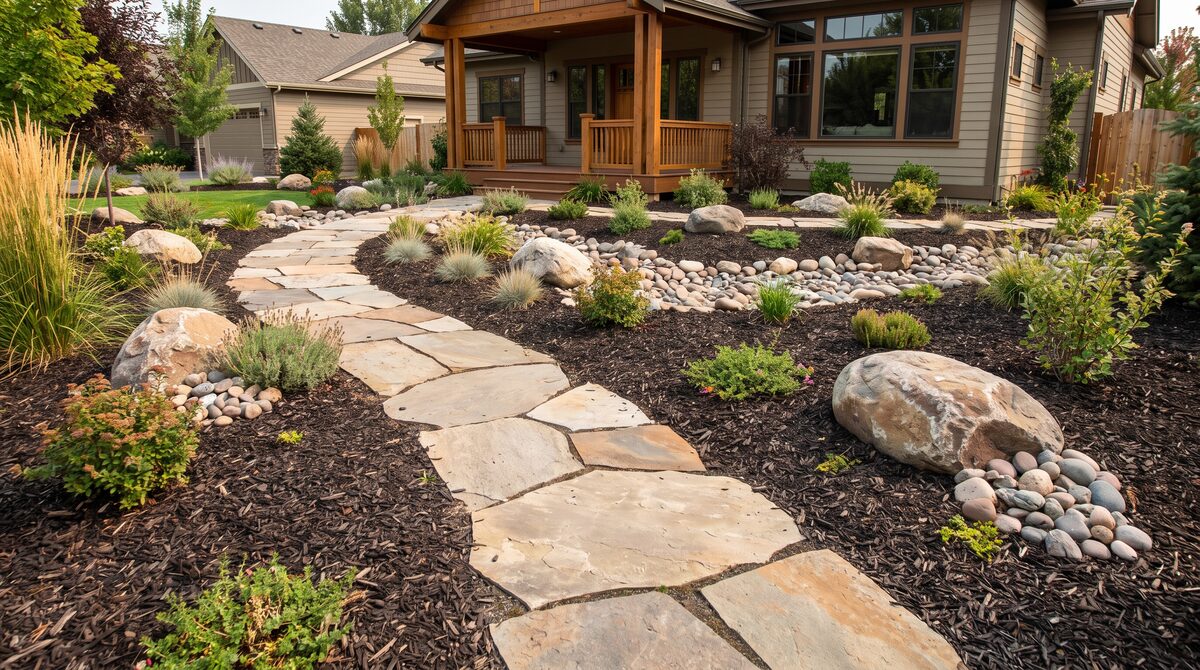
In this design, a twelve- to eighteen-inch strip of clean, medium-sized crushed rock or river gravel is installed directly against the house foundation, laid over commercial-grade landscape fabric without any plantings. This creates an inorganic, fire-resistant, fast-draining “splash apron” that keeps moist organic matter completely away from your siding, weep holes, and foundation walls.
Beyond that initial gravel border, the bed transitions into traditional organic mulch where your foundation shrubs, perennials, and ornamental trees are actually planted. An edging strip separates the stone from the mulch to keep them from mingling.
This hybrid layout delivers the best of both worlds: your home maintains a dry, pest-resistant buffer where it matters most, while your foundation plants enjoy the cool, nutrient-rich soil conditions made possible by organic mulch.
Choosing the Right Approach for Your Home
If a hybrid design does not suit your property, your final decision should come down to local climate, architectural details, and plant selections.
Choose rock if you live in an arid, fire-prone, or excessively windy region where organic mulch dries out quickly or blows away. Stone is also the superior choice if your roof lacks gutters and heavy roof runoff consistently displaces bark, or if your siding sits unusually low to the ground and leaves less than six inches of clearance above the soil line. Pair rock with heat-tolerant, drought-hardy plantings such as junipers, ornamental grasses, agave, and native succulents.
Choose organic mulch if you live in a region with hot summers and you want a lush, verdant foundation planting featuring classic shrubs like boxwoods, hydrangeas, or yews. Mulch is also the practical choice if you enjoy updating your garden layout periodically, as it allows you to divide perennials and add new plantings without wrestling heavy stone and tearing landscape fabric. Just remain diligent about maintaining that critical clearance against the foundation wall to protect the structural integrity of your home.