
3
A garage often doubles as the hardest-working space on a property. It serves as a woodworking shop, an automotive bay, a home gym, and a storage depot for seasonal equipment. Yet for roughly four to five months out of the year, millions of homeowners abandon their projects entirely because their workspace transforms into a stifling, heat-trapping furnace. Stepping inside during mid-afternoon feels like walking into an oven, making any focused manual labor uncomfortable and exhausting.
Cooling a garage requires a fundamentally different strategy than cooling an interior room. Most residential garages were never designed to be climate-controlled. Builders construct them with minimal insulation, loose weatherstripping, unsealed ceiling access hatches, and thin, uninsulated overhead doors that face directly into the afternoon sun. Simply plugging in a pedestal fan rarely solves the problem; it merely circulates stagnant, superheated air across your skin like a convection oven.
Transforming a sweltering garage into a functional, year-round workspace requires understanding how heat infiltrates the structure, blocking that thermal transfer, and choosing an active cooling method suited to your climate and budget.
Diagnosing Why Garages Turn Into Heat Traps
Before investing in equipment, you need to understand how heat accumulates inside a garage. Most garages struggle against three compounding thermal sources: direct solar radiation, lack of thermal resistance, and internal heat loads.
Solar radiation is typically the biggest culprit. If your garage door faces south or west, it absorbs hours of intense sunlight. Standard thin-gauge steel garage doors have virtually no insulating properties, meaning their surface temperature can easily exceed 130 degrees Fahrenheit on a 90-degree day. That metal acts as a massive thermal radiator, broadcasting heat inward long after the sun goes down.
The second factor is the unfinished or semi-finished building envelope. Even in homes where interior living spaces have thick exterior insulation, the exterior walls and ceiling of the garage often receive only the bare minimum required by local building code. Hot air in the attic space radiates downward through the drywall ceiling, while air leaks around door frames allow ambient outdoor heat to seep in continuously.
Finally, many homeowners inadvertently introduce their own heat sources. Parking a recently driven car inside an enclosed garage introduces an engine block and exhaust system radiating heat at temperatures between 200 and 600 degrees Fahrenheit. That parked vehicle acts as a giant space heater, radiating hundreds of thousands of BTUs into the enclosed space over several hours.
Fortifying the Boundary: Insulation and Weatherization
Active cooling equipment cannot perform efficiently if the building envelope is full of leaks. Trying to cool an uninsulated garage is like running an air conditioner with the windows open. Addressing the envelope must always come first.
Upgrading the Overhead Garage Door
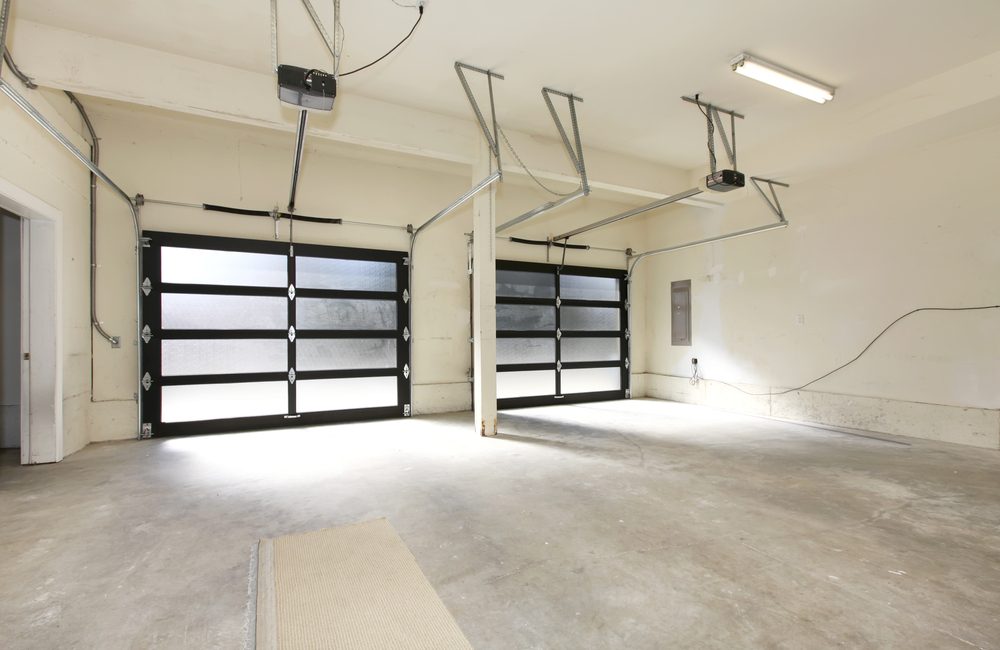
Because the overhead garage door makes up the largest single exterior surface of the room, it represents the greatest thermal liability. Replacing a single-layer metal door with a factory-insulated door featuring a high R-value is the premier solution, but it is not the only option.
Homeowners can retrofit existing steel doors with DIY garage door insulation kits. These kits generally use either reflective radiant barrier panels or rigid expanded polystyrene foam inserts scored to fit within the steel door channels. Rigid foam boards provide solid conductive thermal resistance, while radiant barriers reflect incoming radiant heat back outside.
Equally critical is the perimeter seal. Inspect the rubber weatherstripping along the sides and top of the door frame, as well as the vinyl bottom seal that contacts the concrete floor. Over time, sunlight dry-rots vinyl seals, and settling concrete creates uneven gaps. Installing a heavy-duty, commercial-grade rubber astragal on the bottom of the door and fresh vinyl stop-molding around the exterior frame prevents superheated driveway air from drafting underneath.
Sealing the Ceiling and Attic Access
Heat rises, but radiant heat from a baking asphalt shingle roof travels downward through the garage ceiling with surprising force. If your garage ceiling is open to bare framing or rafter ties, installing drywall along with fiberglass or rockwool batt insulation will make a dramatic difference.
For garages that already have finished drywall ceilings, the pull-down attic stairs or scuttle hatch is almost always unsealed. This opening acts as a chimney in reverse during the summer, dumping superheated attic air directly into the workspace. Installing an insulated attic tent cover over pull-down ladders or gluing two-inch rigid foam board to the top of a push-up access hatch will close off one of the largest thermal leaks in the ceiling.
Air Movement and Strategic Ventilation
Once the envelope is sealed against external infiltration, the next step involves managing the air inside the space. Air movement alone does not lower the temperature on a thermometer, but it dramatically increases evaporative cooling on the human body while flushing out trapped heat.
The Mechanics of Cross-Ventilation
Standard oscillating floor fans simply push existing hot air back and forth. Effective ventilation requires bringing in cooler ambient air from one low point and exhausting hot air out a high point.
If your garage has a side access door and an opposing window, you can create a deliberate cross-breeze. Position an industrial barrel fan or high-velocity air mover near the door or window, pointing outward to exhaust hot air. This creates negative pressure that draws cooler air in through the opposite opening. This tactic is especially effective during early morning or late evening hours when the outside air drops below the garage’s internal temperature.
Dedicated Exhaust Fans
For garages without opposing windows, wall-mounted or ceiling-mounted exhaust fans offer a permanent ventilation route. A high-CFM shutter exhaust fan mounted high on a gable wall can pull stagnant, rising heat straight out of the building.
When calculating ventilation needs for a workshop, aim for enough airflow to replace the entire volume of garage air every two to three minutes. To maintain balance, provide a dedicated low-level intake, such as a screened lower vent or a slightly cracked garage door, so the exhaust fan does not pull air from inside your home through shared interior walls.
Active Cooling Solutions: Matching Equipment to Climate
Ventilation and insulation lower the thermal load, but when summer reaches its peak, active cooling becomes necessary to create a truly comfortable workspace. The right cooling equipment depends heavily on the relative humidity of your geographical region.
Evaporative Coolers for Arid Climates
In dry regions like the American Southwest and parts of the Mountain West, evaporative coolers, commonly called swamp coolers, offer an energy-efficient cooling method. These units pull hot, dry air through water-saturated pads, using the physics of evaporation to drop air temperatures by 15 to 25 degrees while consuming a fraction of the electricity used by traditional compressors.
However, evaporative coolers have strict limitations. They require a continuous fresh-air intake and an open exhaust point to work, and they add substantial humidity to the room. In humid climates like the Southeast or Midwest, evaporative cooling is ineffective because saturated air cannot absorb additional moisture. Furthermore, the elevated humidity produced by swamp coolers can cause cast-iron tool tables, hand planes, and automotive parts to rust rapidly.
Window and Wall-Mounted Air Conditioners
For humid climates, refrigerant-based air conditioning is essential because it simultaneously lowers air temperature and extracts moisture. A window unit or through-the-wall air conditioner is often the most accessible option for a standalone garage.
Sizing the unit correctly is critical. Traditional residential HVAC sizing rules do not apply directly to garages because the cooling loads are significantly higher. A standard two-car garage of roughly 400 to 500 square feet often requires an air conditioner rated between 12,000 and 18,000 BTUs to overcome uninsulated concrete floors and heat-radiating walls.
Installing a through-the-wall unit requires cutting through the exterior siding and framing out a header, but it keeps windows functional and provides a secure, permanent seal against drafts. Ensure that your garage’s electrical subpanel has dedicated breaker capacity, as units operating above 12,000 BTUs frequently require a dedicated 220-volt circuit.
Ductless Mini-Split Systems: The Workshop Standard
If budget allows, a ductless mini-split heat pump represents the gold standard for workshop climate control. These systems use a quiet outdoor compressor connected to a sleek, wall-mounted indoor air handler via small refrigerant lines.
Mini-splits offer exceptional seasonal energy efficiency ratings and operate with variable-speed inverter compressors, meaning they adjust their output dynamically to maintain a steady temperature rather than cycling loudly on and off. They require only a small three-inch hole through the exterior wall, eliminating the security and weather-sealing compromises of window units.
An additional benefit of a mini-split is year-round utility. Because it is a heat pump, the same system that keeps your garage at a comfortable 72 degrees in July can heat the workshop efficiently throughout the winter, protecting delicate materials like glue, paint, finishes, and batteries from freezing.
Operational Habits That Prevent Heat Buildup
Mechanical systems perform best when paired with thoughtful daily habits. Modifying how and when you use the garage can prevent heat from accumulating in the first place.
Keep hot vehicles outside until they cool down. If you commute home in the afternoon, leave your car parked in the driveway for an hour or two with the hood cracked slightly before pulling it into the garage. This single habit keeps an enormous amount of thermal energy out of the room.
Swap out heat-generating light fixtures. Older fluorescent ballasts and halogen work lamps emit surprising amounts of radiant heat into small spaces. Upgrading to modern high-output LED fixtures lowers your electric bill, improves task visibility, and runs virtually cool to the touch.
Schedule demanding physical projects around solar patterns. Undertake sawing, sanding, welding, or heavy automotive repair during early morning hours before the building absorbs the midday solar load. Reserve the hottest hours of late afternoon for low-effort organization or indoor planning.
Applying these methods systematically turns a hostile, sweltering garage back into the productive workspace it was meant to be. By insulating vulnerable surfaces, encouraging air exchange, and applying climate-appropriate cooling, you can build a workshop that remains comfortable through the hottest stretches of the year.